
Rome is one of those rare cities where you can stand in a single spot and see three millennia of human history layered on top of itself. A medieval church built over a Roman temple. A Baroque fountain fed by an ancient aqueduct. A Renaissance palazzo whose foundations rest on Republican-era walls. This is the Centro Storico, the historic center of Rome, and walking through it is less like visiting a museum and more like moving through time itself.

I have worked across dozens of destinations in this industry, and I still find it difficult to describe what makes Rome’s historic center different from every other old city in Europe. It’s not just the quantity of what survives here, though the numbers are staggering (over 25,000 points of archaeological and environmental interest within the UNESCO-protected zone alone). It’s the fact that all of it is still in use. Romans don’t preserve their history behind glass. They live in it, eat in it, argue in it, and park their Vespas next to it.
The Shape of the Centro Storico

The historic center of Rome, inscribed as a UNESCO World Heritage Site in 1980 and expanded in 1990, covers roughly 14 square kilometers enclosed within the 17th-century walls of Pope Urban VIII. Within this area lie 22 rioni, the traditional Roman districts whose names alone tell stories: Campo Marzio, Parione, Pigna, Monti, Trevi, Ponte, Regola.
Each rione has its own character. Parione, home to Piazza Navona and Campo de’ Fiori, is theatrical and social, built for public life. Pigna, where the Pantheon sits, is denser and more inward-looking. Monti, the oldest inhabited neighborhood in Rome, has reinvented itself as a hub of independent boutiques and wine bars without losing its working-class roots. Trevi revolves, inevitably, around one of the most visited monuments on Earth.
The geography matters. Rome was founded on seven hills along the Tiber River, and the Centro Storico sprawls across several of them. The Capitoline, Palatine, Esquiline, Quirinal, and parts of the Aventine all fall within its boundaries. The terrain creates constant shifts in elevation, which means that walking through the center involves climbs and descents that open unexpected views at nearly every turn.
Where Antiquity Meets the Street

The ancient core of the city clusters around the Roman Forum, the Palatine Hill, and the Colosseum. The Forum was the political, commercial, and religious heart of the Roman Republic and Empire for over a thousand years. What remains today, the columns of the Temple of Saturn, the Arch of Septimius Severus, the Basilica of Maxentius, reads like a catalog of the civilization that shaped Western law, engineering, and governance. The Palatine Hill, rising directly above the Forum, holds the ruins of imperial palaces where Augustus, Tiberius, and Domitian once governed an empire that stretched from Britain to Mesopotamia.
The Colosseum, completed in 80 AD under Emperor Titus, could seat approximately 50,000 spectators and remains the largest amphitheater ever built. Its engineering innovations, including a retractable awning system called the velarium, underground staging areas, and a sophisticated network of entrances and exits that could empty the entire building in minutes, influenced stadium design for centuries.

But ancient Rome is not confined to the Forum area. The Pantheon, rebuilt by Emperor Hadrian around 126 AD, stands in the heart of the Centro Storico as arguably the best-preserved building of classical antiquity. Its unreinforced concrete dome, measuring 43.3 meters in diameter, remained the largest in the world for over 1,300 years. The oculus, a circular opening of roughly 8 meters at the dome’s apex, serves as the only source of natural light, casting a beam that moves across the interior like a slow-motion sundial. On April 21st, the legendary founding date of Rome, sunlight entering through the oculus perfectly illuminates the entrance at noon. The building has been in continuous use for nearly two millennia, first as a temple to all Roman gods, then as a Christian church since 609 AD. Raphael is buried here, as are two Italian kings.
Nearby, the Largo di Torre Argentina preserves four Republican-era temples and is traditionally identified as the site where Julius Caesar was assassinated on the Ides of March, 44 BC.
Baroque Rome and the Piazzas

If antiquity gives Rome its bones, the Baroque period gave it its personality. The 17th and 18th centuries transformed the Centro Storico into an open-air gallery of fountains, churches, and public spaces designed to impress, persuade, and overwhelm.
Piazza Navona, built over the ruins of the Stadium of Domitian, is the finest Baroque square in the city. Bernini’s Fontana dei Quattro Fiumi (Fountain of the Four Rivers) occupies the center, with allegorical figures representing the Nile, Ganges, Danube, and Río de la Plata. The church of Sant’Agnese in Agone, designed by Borromini, faces the fountain directly, and the (probably invented) rivalry between the two architects has become one of Rome’s favorite stories.
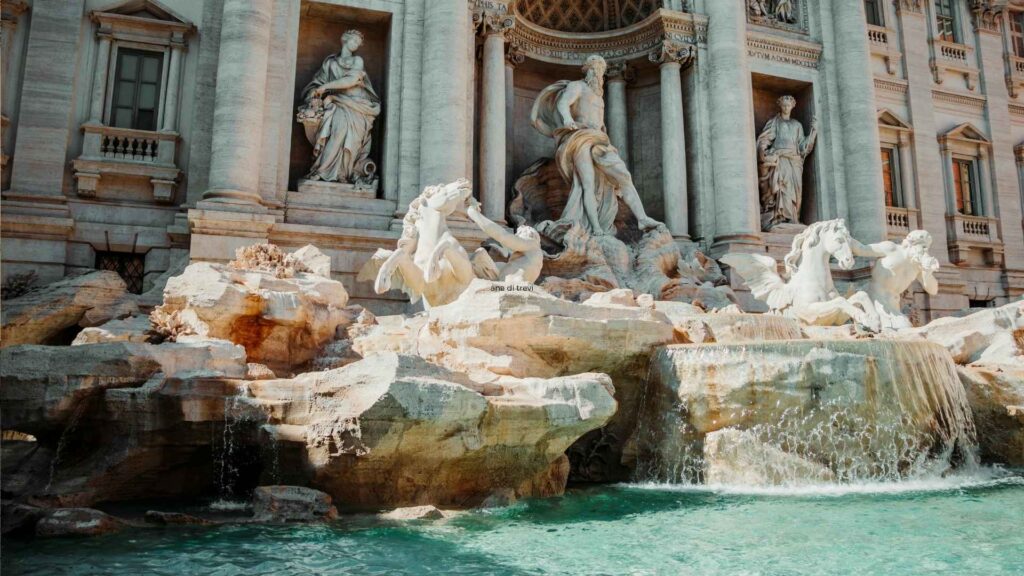
The Trevi Fountain, designed by Nicola Salvi and completed in 1762, is the largest Baroque fountain in the city and the terminus of the ancient Aqua Virgo aqueduct, which has been supplying water to this part of Rome since 19 BC. The tradition of throwing a coin over your left shoulder to ensure a return to Rome generates an estimated 1.5 million euros annually, which the city donates to charity.
The Spanish Steps, connecting Piazza di Spagna at the base to the Trinità dei Monti church at the top, were built in the 1720s to link the Spanish Embassy to the French church above. The surrounding streets, Via dei Condotti, Via Frattina, and Via Borgognona, now form Rome’s luxury shopping district.
For travelers who want to understand how these layers connect, from the Republican temples buried beneath Baroque churches to the Renaissance frescoes hidden in side chapels, a guided walking tour through the Centro Storico provides context that is nearly impossible to piece together on your own. The density of what’s here rewards explanation.
Eating Through the Centro Storico

Roman cuisine is direct, seasonal, and built on a small number of ingredients handled with precision. The historic center is where you’ll find the full range, from centuries-old trattorias to market stalls to high-end restaurants working within the Roman tradition.
The four canonical Roman pasta dishes, cacio e pepe, carbonara, amatriciana, and gricia, are available everywhere, but the quality varies enormously. The best versions tend to come from kitchens that source their guanciale (cured pork jowl) and pecorino romano from producers in Lazio and treat the technique with the seriousness it deserves. Simplicity, in Roman cooking, is not a shortcut. It’s a discipline.
Campo de’ Fiori hosts one of the city’s most established open-air markets, operating every morning except Sunday. The stalls sell seasonal produce, dried herbs, cured meats, and artisan cheeses. The surrounding streets are dense with restaurants, though the piazza itself has increasingly catered to tourists. Walking a block or two in any direction tends to improve both quality and price.

The Jewish Ghetto, adjacent to the Centro Storico’s southern edge along the Tiber, adds another culinary layer. Roman-Jewish cuisine, one of the oldest continuous food traditions in Europe, gave the city dishes like carciofi alla giudia (deep-fried artichokes) and filetti di baccalà (fried salt cod). These dishes originated from the constraints of kosher cooking combined with local Roman ingredients, and they remain an essential part of the city’s food identity.
A food tour through the historic center connects these traditions in a way that eating at individual restaurants cannot. You begin to see how geography, religion, trade, and seasonal availability shaped what Romans eat, and why certain dishes exist only here. For visitors who want to take that understanding even further, cooking classes in the center teach the techniques behind Roman pasta, seasonal antipasti, and traditional desserts, turning a meal into a skill you bring home.
The Practical Realities

Rome’s Centro Storico is best navigated on foot. The cobblestone streets and pedestrian zones make driving impractical. Metro Line A stops at Spagna (for the Spanish Steps) and Barberini (for the Trevi Fountain area), while numerous bus lines cross the center.
The density of attractions means that even short walks between landmarks pass through centuries of architecture. A ten-minute stroll from the Pantheon to Piazza Navona takes you through streets where every building has a story, and where the afternoon light hitting a travertine facade can stop you in your tracks.
Rome’s historic center is not a place you conquer in a day, or even a week. It is a place that reveals itself gradually, one piazza, one church, one plate of carbonara at a time. The travelers who get the most from it are the ones who resist the urge to see everything and instead allow themselves to see a few things deeply. The city has been here for nearly three thousand years. It will wait for you to come back.
