
There is a triangle of ancient ground in the heart of Rome where the entire arc of Western civilization can be traced on foot in a single morning. The Palatine Hill, where Romulus is said to have founded the city in 753 BC. The Roman Forum, where the Republic debated its laws and the Empire displayed its power. And the Colosseum, where up to 50,000 spectators gathered to watch spectacles that defined the meaning of public entertainment for four centuries. These three sites share a single ticket, a single archaeological park, and a continuous thread of history that stretches from the mythological origins of Rome to the fall of the Western Empire.
I have visited this complex many times, in every season and at every hour. And the one thing I always notice is how many visitors rush through the Forum and Palatine after spending most of their time inside the Colosseum. That’s understandable, because the Colosseum is visually spectacular and immediately recognizable. But the Forum and the Palatine are where Rome actually happened. Skipping them is like reading the last chapter of a book and ignoring the rest.
The Colosseum: Engineering as Spectacle

The Colosseum, officially the Amphitheatrum Flavium, was commissioned around 70-72 AD by Emperor Vespasian as a gift to the Roman people. The choice of location was itself a political statement: Vespasian built it on the site of the artificial lake that had been part of Nero’s Domus Aurea, the extravagant private palace that the previous emperor had built for himself after the Great Fire of 64 AD. Where Nero had seized public land for personal pleasure, the Flavian dynasty returned it to the people.
The construction was financed with spoils from the Roman conquest of Jerusalem during the First Jewish-Roman War, and the labor force included thousands of prisoners brought back from Judea. Travertine limestone was quarried in Tivoli, roughly 30 kilometers east. The building was completed in 80 AD by Vespasian’s son Titus, who inaugurated it with 100 consecutive days of games. Emperor Domitian later added the fourth story and the underground network of tunnels known as the hypogeum.
The numbers remain staggering. The elliptical structure measures 189 by 156 meters and originally stood four stories tall, with 80 entrance arches that allowed the entire capacity of 50,000 spectators to enter or exit in approximately 15 minutes. The exterior facade rose through three orders of decorative columns (Doric, Ionic, and Corinthian), and a retractable canvas awning called the velarium, operated by a detachment of sailors from the Roman navy, shielded spectators from the sun and rain.
Beneath the arena floor, the hypogeum contained corridors, animal cages, and mechanical lifts that could raise scenery, wild animals, and gladiators directly into the arena through trapdoors. The system could stage elaborate hunts, public executions, and gladiatorial combat in rapid succession.
The name “Colosseum” likely derives not from the building’s size but from the Colossus of Nero, a 30-meter bronze statue that once stood nearby and was later modified to represent the sun god Sol.
After four centuries of active use, the Colosseum fell into neglect. Earthquakes damaged the southern wall, and for centuries its travertine blocks were stripped for buildings across Rome, including St. Peter’s Basilica. What survives is roughly one-third of the original, but it remains the largest standing amphitheater in the world.
The Roman Forum: Where a Republic Built Itself
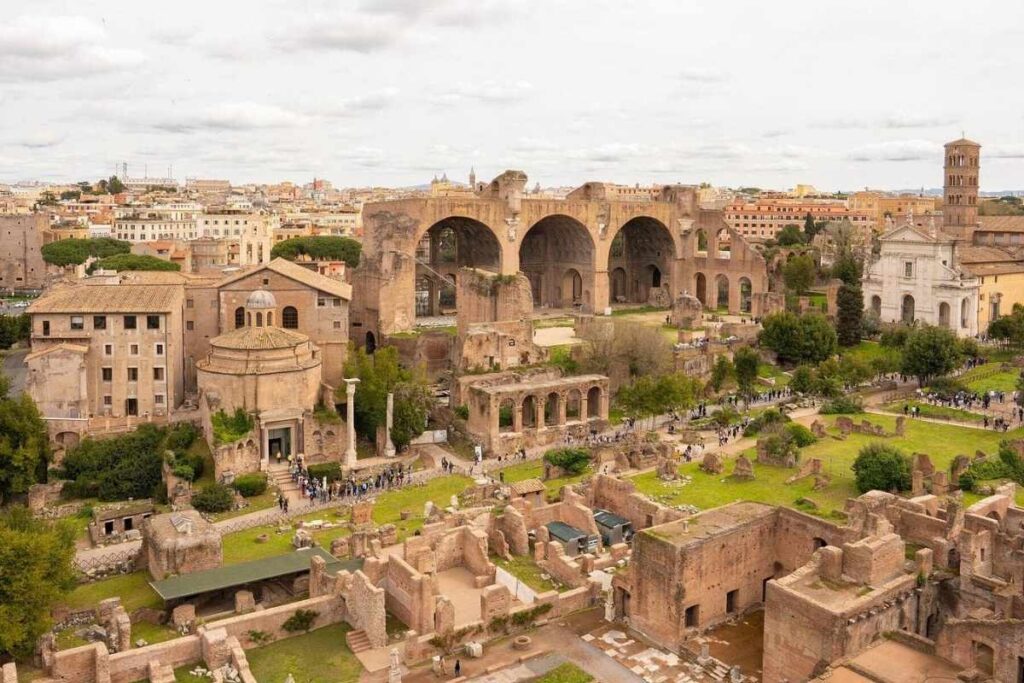
Just west of the Colosseum, the Roman Forum occupies a long, narrow valley between the Capitoline and Palatine Hills. This was the political, religious, commercial, and legal heart of Rome for over a thousand years. Today it reads as a sprawling field of ruins, columns, and partial walls that can feel disorienting without context. But when you understand what stood here, the scattered stones begin to speak.
The site was originally a marshy burial ground, drained in the 7th century BC by the Cloaca Maxima, one of the world’s earliest sewage systems. Once drained, the valley became Rome’s central public space, its downtown, and the buildings that filled it over the following centuries reflected every phase of the city’s transformation from kingdom to republic to empire.
The Via Sacra, the Sacred Way, was the Forum’s main artery, connecting the Colosseum to the Capitoline Hill. Every triumphal procession and state funeral passed along it. When Julius Caesar returned from the Gallic Wars in 46 BC, the captured Gaulish leader Vercingetorix was paraded in chains along this road.
The Curia Julia, commissioned by Caesar and completed by Augustus, served as the meeting place of the Roman Senate. Its brick exterior and intact roof make it one of the best-preserved buildings in the Forum, partly because it was converted into a church during the Middle Ages.
The Temple of Saturn, with its eight surviving granite columns, was one of the Forum’s oldest structures, dedicated to the god of agriculture and doubling as the state treasury. The Arch of Septimius Severus and the Arch of Titus frame the Forum’s two ends. The Temple of Vesta, where the Vestal Virgins maintained the sacred eternal flame, sits near the eastern edge. And the Rostra, the speaking platform decorated with prows of captured ships, is where Cicero and Mark Antony addressed the people.
The Forum declined after the fall of the Western Empire. It was used as a cattle pasture for centuries, and medieval Romans called it Campo Vaccino. Systematic excavation began only in the 18th century.
The Palatine Hill: Where Rome Began
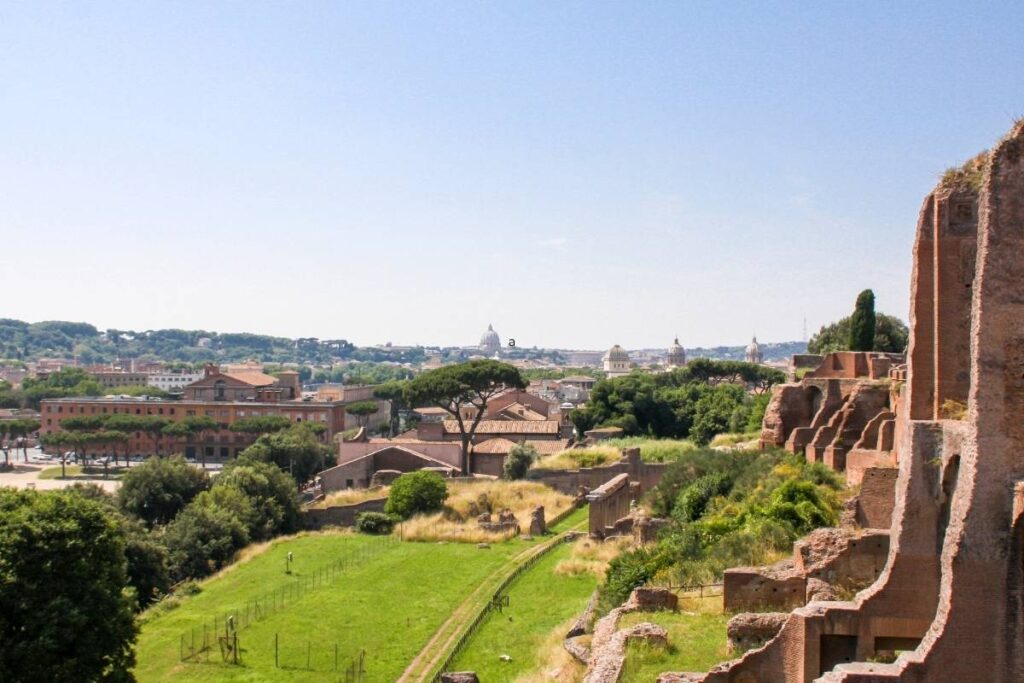
Rising 40 meters above the Forum, the Palatine Hill is the most central of Rome’s seven hills and the place where, according to mythology, the story of Rome itself begins. It was here that the she-wolf found the abandoned twins Romulus and Remus in a cave called the Lupercal. When Romulus decided to found a city, he chose this hill. Archaeological evidence supports the mythology to a degree: excavations have uncovered Iron Age hut foundations dating to roughly the 8th century BC, matching the traditional founding date of 753 BC. These remains, known as the Hut of Romulus, represent some of the oldest traces of habitation in Rome.
During the Republic, the Palatine became the most exclusive residential district in the city. Rome’s wealthiest citizens, including Cicero and Crassus, built their villas here. When Augustus became Rome’s first emperor, he established his residence on the Palatine, initially in a modest home that later expanded as he acquired neighboring properties. The House of Augustus and the adjacent House of Livia, his wife, are partially preserved and contain some of the finest Pompeian-style frescoes surviving in Rome.
Every emperor who followed built on the Palatine. Tiberius constructed a palace on the northwestern side. Nero built the Domus Transitoria before the infamous Domus Aurea. But it was Domitian who transformed the hill into the sprawling imperial complex whose ruins dominate the site today. The Domus Flavia served official functions with reception halls and a grand dining room. The Domus Augustana was the emperor’s private residence. And the Stadium of Domitian, a sunken rectangular arena, likely served as a private garden or exercise track.
The word “palace” itself derives from Palatium, the Latin name for this hill. Every palace ever built, in every language, carries in its name the memory of where Roman emperors chose to live.
From the Palatine’s southern edge, the view drops to the Circus Maximus, the chariot-racing stadium that once seated 250,000 spectators. From the northern terrace, the entire Roman Forum spreads below.
Making the Visit Count

These three sites form a single archaeological park, and a combined ticket covers all of them. But the sheer scale of the complex, seven kilometers of walkable ground across exposed, unshaded terrain, makes planning essential. Most visitors spend the majority of their time inside the Colosseum and then pass quickly through the Forum and Palatine, which is a mistake. The Forum and Palatine are where the context lives, and without them, the Colosseum is just a building.
The most effective way to experience all three is through a guided tour of approximately three hours that includes skip-the-line access, audio headsets, and a licensed guide. A good guide does something no sign or audio app can replicate: they connect the Colosseum’s engineering to the political ambitions of the Flavian dynasty, explain how the Forum’s layout reflected the power struggles of the Republic, and show you where Augustus actually lived on the Palatine. Groups are capped at 24 people, and the structured itinerary ensures you spend meaningful time at each site rather than wandering and guessing.
Wear comfortable shoes, bring water, and arrive early. Much of the site is exposed, and summer temperatures can be relentless. And if you have the energy, stay on the Palatine after the tour ends. The crowds thin, the light softens, and you can sit on the hill where Rome was born and look out over the city it became.