
There is a statistic about the Vatican Museums that puts the entire visit into perspective before you even walk through the door: if you stood in front of every single work of art for just one minute, it would take you roughly twelve years to see everything. The collection spans over 70,000 objects across 54 galleries, corridors, and chapels, accumulated by the Catholic Church and the papacy over five centuries. And at the end of the route, waiting beyond the last gallery, sits the Sistine Chapel, a room that contains what many consider the single greatest artistic achievement in Western civilization.
I have guided hospitality professionals through this complex, helped tour operators design itineraries around it, and visited it myself more times than I can count. And the one thing I tell everyone is the same: do not try to see it all. The Vatican Museums reward focus, not endurance. Pick the rooms that matter most, understand what you’re looking at, and let the rest wait for another visit.
👉 Book your Vativan Museums, Sistine Chapel and St. Peter’s Basilica Guided Tour
Where It All Began

The Vatican Museums trace their origin to a single sculpture. On January 14, 1506, a Roman vineyard near the Basilica of Santa Maria Maggiore yielded a marble group that had been buried for over a thousand years. Pope Julius II sent his architect Giuliano da Sangallo and a young Michelangelo to examine the find. It was the Laocoön and His Sons, a first-century Roman sculpture depicting the Trojan priest and his children being strangled by sea serpents, a scene described by Virgil in the Aeneid. Julius purchased the piece and placed it in the Cortile delle Statue (now the Octagonal Courtyard), where it became the foundation of what would grow into one of the largest museum complexes on Earth.
Every pope who followed added to the collection. Clement XIV and Pius VI established the Museo Pio-Clementino in the late 18th century for Greek and Roman antiquities. Gregory XVI founded the Egyptian and Etruscan museums in the 1830s. Pius XI commissioned the Pinacoteca Vaticana, which opened in 1932 with works by Giotto, Leonardo da Vinci, Raphael, and Caravaggio.
The result is not a single museum but a constellation of collections within the Apostolic Palace, connected by a one-way route that runs approximately seven kilometers.
The Galleries You Should Not Miss
The sheer scale of the Vatican Museums makes selective visiting essential. Here are the rooms and collections that carry the most weight.
The Museo Pio-Clementino

This is where the classical world lives inside the Vatican. Twelve rooms of Greek and Roman sculpture include the Apollo Belvedere, the Belvedere Torso (which Michelangelo studied obsessively and which directly influenced his figures on the Sistine ceiling), and the Laocoön itself, still in the courtyard where Julius II first displayed it. The Sala Rotonda, shaped like a miniature Pantheon, contains ancient mosaics and a gilded bronze Hercules that survived the centuries by being buried in mud.
The Gallery of Maps
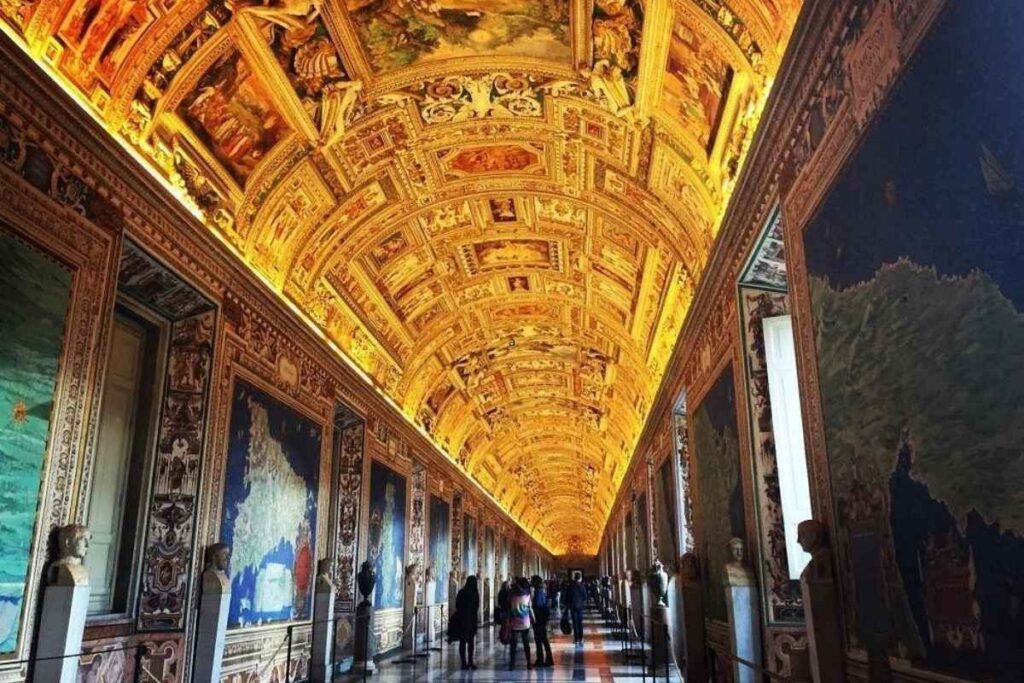
This 120-meter corridor, commissioned by Pope Gregory XIII between 1580 and 1585, is one of the most visually overwhelming spaces in the complex. Forty topographical maps of the Italian peninsula, painted under the direction of friar and cosmographer Ignazio Danti, cover the walls from floor to ceiling. Each map depicts a different region of Italy with remarkable accuracy for its era, and the vaulted ceiling above is entirely covered in gilded frescoes depicting religious events associated with each territory. Most visitors arrive here on the standard route toward the Sistine Chapel expecting a hallway. What they find stops them in their tracks.
The Raphael Rooms
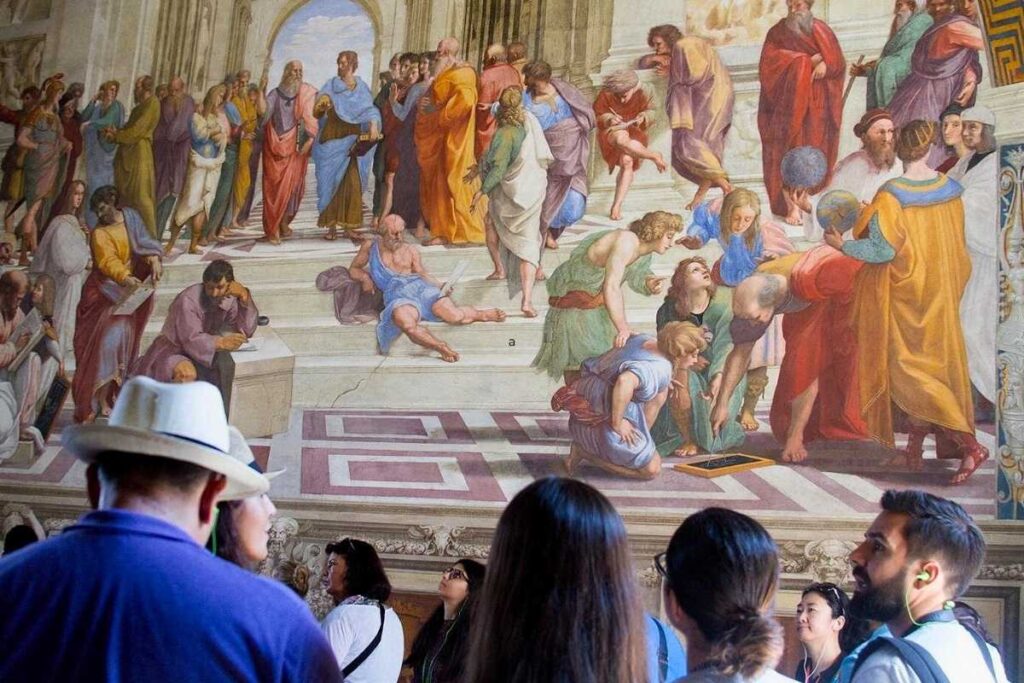
These four interconnected rooms were originally the private apartments of Pope Julius II. Around 1508, Julius commissioned a young Raphael to decorate them, reportedly because he refused to live in the Borgia Apartments of his predecessor, Pope Alexander VI.
The most celebrated room is the Stanza della Segnatura, which contains The School of Athens, arguably the defining image of Renaissance humanism. The fresco depicts the greatest minds of antiquity gathered in a single space: Plato and Aristotle at the center, Pythagoras writing in the foreground, Euclid bent over a geometric proof. Raphael included a self-portrait among the philosophers on the far right and gave Plato the face of Leonardo da Vinci.
The remaining rooms contain The Expulsion of Heliodorus, The Fire in the Borgo, and the Hall of Constantine, finished after Raphael’s death in 1520 by his assistants Giulio Romano, Gianfrancesco Penni, and Raffaellino del Colle.
An important practical note: once you enter the Sistine Chapel, you cannot return to the Raphael Rooms. Take your time here before moving on.
The Sistine Chapel

Everything in the Vatican Museums builds toward this room. The chapel was constructed in the 1470s under Pope Sixtus IV (hence the name) as the official chapel of the Apostolic Palace, and its original wall frescoes were painted by some of the finest artists of the late 15th century, including Botticelli, Perugino, and Ghirlandaio.
Then, in 1508, Pope Julius II asked Michelangelo to repaint the ceiling.
Michelangelo did not want the commission. He considered himself a sculptor, not a painter, and suspected that rivals (possibly Raphael’s circle) had suggested the project hoping he would fail. He accepted reluctantly, dismissed his assistants, and spent four years working largely alone on scaffolding he designed himself, painting over 300 figures across more than 500 square meters of vaulted surface.
The nine central panels depict scenes from the Book of Genesis, from the Separation of Light and Darkness to the Drunkenness of Noah. The Creation of Adam, where the finger of God reaches toward Adam across a gap that is almost but not quite closed, has become one of the most reproduced images in the history of art. The figures surrounding the central panels, the ignudi, the prophets, the sibyls, demonstrate a mastery of human anatomy and compositional drama that influenced every painter who came after.
Twenty-three years later, Michelangelo returned to paint The Last Judgment on the altar wall, a massive composition of over 300 figures rising to heaven or descending into hell. He included his own face, stretched across the flayed skin held by Saint Bartholomew.
The chapel remains a functioning religious space where the College of Cardinals gathers during a papal conclave to elect a new pope. Photography is not permitted, and silence is requested, though neither rule is universally observed.
St. Peter’s Basilica

The standard visitor route through the Vatican Museums exits at the Sistine Chapel and connects, via a dedicated passage available to guided tours, directly to St. Peter’s Basilica, bypassing the often enormous queue in St. Peter’s Square.
The basilica is the largest church in the world, with an interior length of 186 meters and a dome designed by Michelangelo that rises 136 meters above the floor. Construction began in 1506 under Julius II and took over 120 years, involving Bramante, Raphael, Sangallo, and Maderno before Michelangelo took charge of the dome at age 71. He would not live to see it finished.
Inside, the scale is difficult to process. Bernini’s baldachin, the bronze canopy over the papal altar, stands 29 meters tall and was cast from bronze stripped from the portico of the Pantheon. Michelangelo’s Pietà, carved when he was just 24 years old and the only work he ever signed, sits in a chapel near the entrance behind protective glass. The mosaic decorations that cover the interior reproduce famous paintings with such precision that most visitors assume they are looking at painted canvases.
St. Peter’s Square, designed by Bernini, extends from the facade in an elliptical colonnade of 284 Doric columns.
Making the Most of Your Visit

The Vatican Museums received 6.8 million visitors in 2024, making them the second most visited museum in the world after the Louvre. The practical implications of those numbers are real: general admission lines can stretch to two hours or more during peak season, and the interior corridors become densely crowded by mid-morning.
The most effective way to experience the Vatican Museums, the Sistine Chapel, and St. Peter’s Basilica is through a small-group guided tour of around three hours that includes reserved entrance access, audio headsets, and a knowledgeable guide who can navigate the complex efficiently. A good guide does more than point at paintings. They connect the rooms to each other, explain why Julius II’s personality shaped the entire collection, and get you through the Raphael Rooms with enough context to actually understand what Raphael was doing. Groups of twenty or fewer also gain access to the direct passage from the Sistine Chapel into St. Peter’s Basilica, skipping the external queue entirely.
Arrive early. Wear comfortable shoes. Cover your knees and shoulders (this is enforced). And give yourself permission to skip entire sections without guilt. The Vatican took five centuries to build its collection. You are not required to absorb it in an afternoon.